




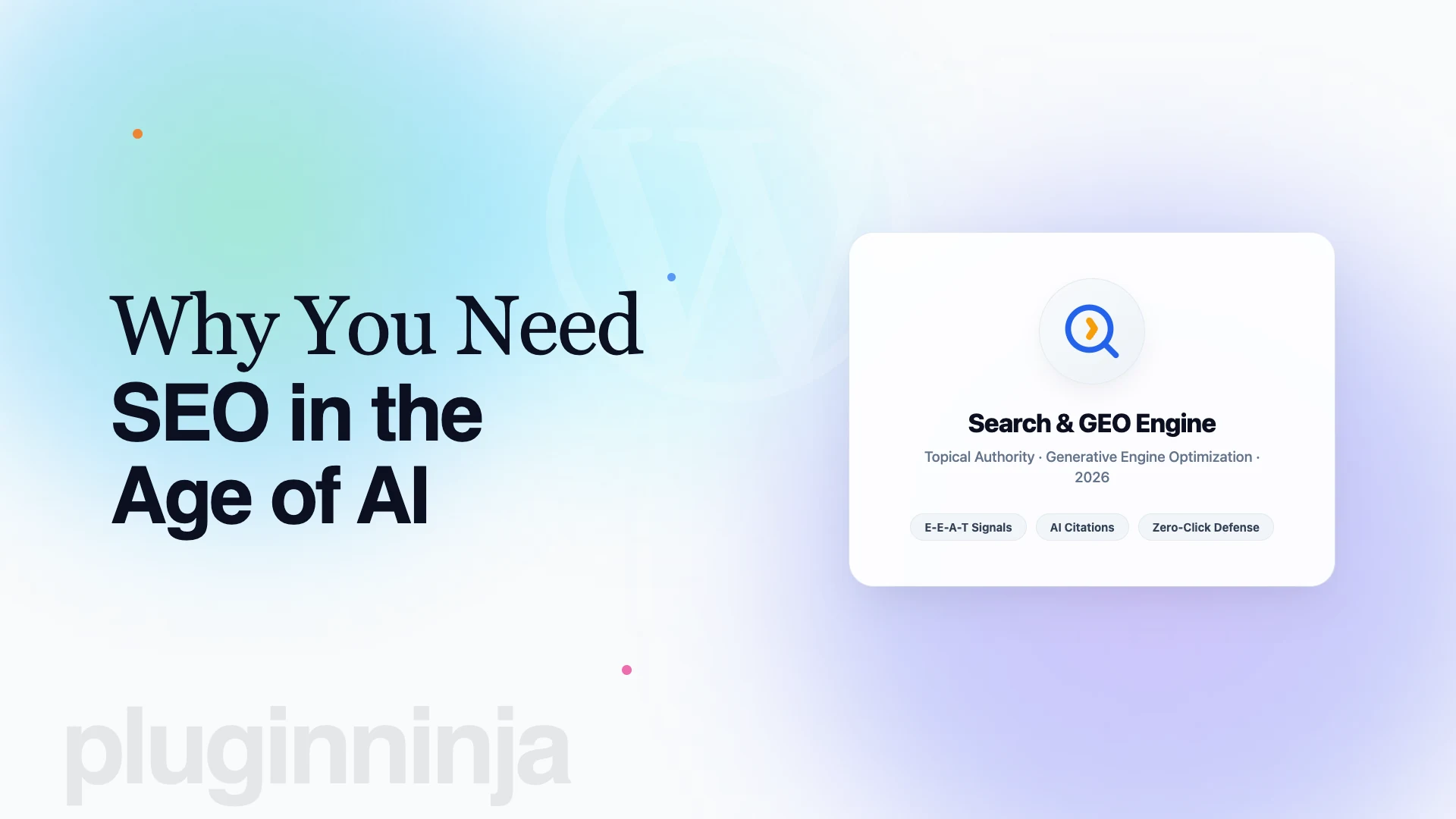
If you’ve typed a question into Google lately and got a full answer without clicking a single link, you’ve experienced the new reality of AI-powered search. Google’s AI Overviews, ChatGPT, Perplexity, and Gemini are reshaping how people find information — and a growing chorus is asking: Is SEO dead in the age of AI?
The short answer: No. SEO isn’t dead — it has evolved into the most critical business infrastructure you can invest in.
This guide breaks down exactly why SEO still matters, what has changed, and how you can future-proof your digital presence right now.
The Search Landscape Has Fundamentally Changed
Traditional search was simple: you typed a keyword, ten blue links appeared, and you clicked one. That era is over.
Today, AI-generated summaries answer queries directly on the search results page — what industry experts call “zero-click” searches. The data is striking:
- ~60% of Google searches now end without a user clicking any external website link.
- When an AI Overview appears, organic click-through rates (CTR) drop by 47% to 61% for traditional listings.
- Organic rankings actually rose by 26% across tracked portfolios — while organic traffic fell by 19% over the same period. (Source: Neil Patel)
This “Great Decoupling” — rankings going up while traffic goes down — is the defining SEO trend of 2026. But here’s the critical nuance: the traffic that does arrive converts up to 4.4× better than standard organic traffic, because AI pre-qualifies and filters users before they click through.
The goal of SEO in 2026 is no longer just to rank — it’s to be recommended, cited, and referenced by AI systems themselves.
6 Reasons SEO Is More Important Than Ever in the AI Era
1. AI Engines Are Fed by SEO-Optimized Content
Here’s the fundamental truth that many people miss: AI tools don’t invent facts — they scrape, index, and synthesize content from the web. ChatGPT, Perplexity, Google Gemini, and others use Retrieval-Augmented Generation (RAG), meaning they pull real-time information from indexed web pages to construct their answers.
If your website isn’t properly crawled, indexed, and trusted by search algorithms, AI systems simply cannot find or use your content. Good SEO is literally what makes you visible to AI discovery. Poor SEO means you’re invisible — not just to humans, but to the machines that now answer for you.
2. E-E-A-T Is Now an AI Trust Signal
Google’s E-E-A-T framework — Experience, Expertise, Authoritativeness, and Trustworthiness — was originally a quality guideline for human reviewers. In the AI era, it has become the primary filter that determines whether an AI engine trusts and cites your content.
AI models are risk-averse. They don’t want to hallucinate false information or recommend unreliable sources. So they lean heavily on signals of real-world credibility:
- ✅ Verified author bios with genuine credentials
- ✅ Original research, proprietary data, and case studies
- ✅ High-quality backlinks from authoritative publications
- ✅ Consistent brand mentions across third-party platforms (Reddit, YouTube, industry forums)
- ✅ First-hand experience content that AI-generated content cannot replicate
Thin, generic, AI-spun content is aggressively filtered out. The brands that win AI citations are those that have invested in real SEO authority-building over time.
3. High-Intent Traffic Still Flows Through Traditional Search
AI Overviews dominate informational queries (“What is X?”), but commercial and transactional searches — “best WordPress plugin for X,” “hire a developer near me,” “buy [product]” — still require deep human research and click-through behaviour.
When someone is ready to spend money or commit to a decision, they don’t just accept a one-paragraph AI summary. They visit websites, read reviews, compare options, and seek depth. SEO is what puts your site in front of those high-value users at the exact moment they’re ready to convert.
4. Structured Content Is the New Language of AI
The shift from keyword stuffing to semantic, well-structured content isn’t a soft recommendation — it’s mandatory for AI-era visibility. Generative AI tools actively prefer content that is:
- Well-organized with clear H2/H3 headings that answer specific sub-questions
- Front-loaded with concise answers in the first 40–80 words of each section
- Schema-marked-up with structured data (FAQ, Article, Organization, Product schemas)
- Logically entity-linked — connecting related topics and concepts clearly
- Formatted for extraction — comparison tables, numbered steps, bullet lists that LLMs can cleanly lift and summarize
These are all SEO best practices that have now become essential for AI discoverability. The discipline of SEO forces you to organize your information in a way that both humans and AI systems can understand and trust.
5. AI Referral Traffic Is the Fastest-Growing Channel
While AI referral traffic is still a fraction of Google’s volume, the growth trajectory is extraordinary. Studies show AI-referred sessions grew by 527% year-over-year as ChatGPT, Claude, Perplexity, and Gemini scaled to hundreds of millions of weekly active users.
Even more compelling: visitors arriving via AI referral sources spend 68% more time on-site than traditional organic visitors. They come pre-informed, already convinced your site is worth reading, and ready to go deeper. Optimizing for AI citation is essentially pre-qualifying your own audience.
Importantly, research from Ahrefs reveals that roughly 80% of sources cited by AI platforms don’t even appear in Google’s top traditional organic results. There is a distinct, parallel SEO game being played for AI visibility — and most brands haven’t even started playing it.
6. Search Is Everywhere — SEO Principles Travel With It
Search is no longer a single destination at Google.com. Users discover answers across:
- Google AI Overviews & traditional SERPs
- ChatGPT, Perplexity, and Claude chat interfaces
- YouTube, TikTok, and social search
- Voice assistants and smart devices
- In-app search within platforms like Reddit, LinkedIn, and Amazon
The underlying mechanics across all of these channels are rooted in SEO principles: structured information, strong brand signals, a robust digital footprint, and clear topical authority. Brands that master holistic SEO naturally surface across all of these fragmented discovery channels — not just one.
SEO vs. GEO: Understanding the New Dual Playbook
In 2026, successful digital marketers are running two overlapping strategies:
| Traditional SEO | GEO (Generative Engine Optimization) |
|---|---|
| Rank in Google’s blue links | Get cited inside AI-generated answers |
| Target exact-match keywords | Target topics, entities & conversational queries |
| Build backlinks for PageRank | Build brand mentions & third-party consensus |
| Optimize meta titles & descriptions | Optimize content extractability & schema markup |
| Measure CTR and organic traffic | Measure citation frequency & share of voice in AI answers |
| Chase ranking positions | Build topical authority ecosystems |
The critical insight: GEO is built on top of SEO. You cannot win in generative search without a solid traditional SEO foundation. The two are not competing strategies — they are sequential layers of the same discipline.
6 SEO Best Practices That Are Non-Negotiable in the AI Era
1. Build Real Topical Authority
AI systems look for the definitive source on a topic — not the site that happens to rank for one keyword. Build content clusters: one comprehensive pillar page backed by a network of supporting subtopic pages. Cover your niche deeply, not broadly.
2. Implement Advanced Schema Markup
Structured data has gone from a nice-to-have to a necessity. Use FAQ Schema, Article Schema, Author Schema, and Organization Schema at minimum. Schema markup is how you speak directly to machine parsers — both Google’s crawlers and AI retrieval systems.
3. Allow AI Crawlers Access
Check your robots.txt file. Many sites inadvertently block AI user agents like GPTBot, ClaudeBot, and Google-Extended. Unless you have a specific reason to restrict AI crawling, allow access so your content can be indexed for AI retrieval. Consider also adding an llms.txt file — a clean, text-based site map designed specifically for LLM ingestion.
4. Prioritize Content Freshness
AI retrieval systems heavily favor recently updated content. Studies show that a high percentage of AI-cited URLs were updated or published within a 30-day window. Audit your key pages quarterly — update statistics, refresh examples, and republish with current timestamps to maintain AI relevance.
5. Build Multi-Platform Brand Presence
AI engines don’t just look at your website. They scan Reddit threads, YouTube videos, Quora answers, industry publications, and review platforms to build a consensus view of your brand. A strong, consistent presence across the web — where real people discuss and recommend you — is increasingly what drives AI visibility.
6. Lead With Direct Answers
Structure every important page to answer the core question within the first paragraph. Use question-based H2/H3 headings that mirror natural language queries. Format key information as tables, bullet lists, and numbered steps — the exact formats AI systems prefer to extract and quote.
The Bottom Line: SEO Is Now Business Infrastructure
In the age of AI, SEO has graduated from a marketing tactic into core business infrastructure. It is no longer just about getting clicks — it is about ensuring your brand is recognized, trusted, and recommended by both human users and the artificial intelligence systems they increasingly rely on.
The businesses that dismiss SEO as “dead” in the AI era are making a catastrophic strategic error. They are voluntarily removing themselves from both the traditional search graph and the emerging AI citation ecosystem — essentially becoming invisible to the entire web.
The brands that win in 2026 and beyond are those that recognize a simple truth: AI doesn’t replace SEO. AI makes SEO the most important thing you can invest in.
Frequently Asked Questions
Is SEO dead because of AI?
No. SEO is not dead — it has evolved. AI-powered search engines rely on indexed, crawled, and trusted web content to generate their answers. Without strong SEO, your content is invisible to both traditional search and AI systems. SEO is now more important, not less.
What is GEO (Generative Engine Optimization)?
GEO is the practice of optimizing your content to be cited and referenced inside AI-generated answers from tools like ChatGPT, Perplexity, and Google AI Overviews. It builds on traditional SEO foundations but adds a focus on content extractability, topical authority, and multi-platform brand presence.
How does AI affect organic traffic?
AI Overviews and zero-click searches have reduced raw organic click volume for informational queries. However, traffic that does click through from AI systems converts at up to 4.4× the rate of traditional organic traffic, as users are already pre-qualified by AI before clicking.
How do I optimize for AI search engines?
Focus on: building genuine topical authority, implementing schema markup, allowing AI crawlers in your robots.txt, keeping content fresh, building multi-platform brand mentions, and structuring content with direct answers and extractable formats (tables, lists, numbered steps).
What is E-E-A-T and why does it matter for AI SEO?
E-E-A-T stands for Experience, Expertise, Authoritativeness, and Trustworthiness. It is Google’s quality framework that AI systems use to determine which sources to trust and cite. Content with strong E-E-A-T signals — verified authors, original research, quality backlinks — is far more likely to be referenced in AI-generated answers.
Frequently Asked Questions About SEO in the Age of AI
No, SEO is not dead. AI search systems, including Google AI Overviews, ChatGPT, and Perplexity, do not create information out of thin air. They rely directly on crawled, indexed, and authoritative web pages to generate answers. Without solid technical SEO, content remains invisible to both human users and AI answer bots.
Generative Engine Optimization (GEO) is the practice of optimizing content to be selected, cited, and summarized inside AI-generated answers. While traditional SEO focuses on ranking in standard blue link results, GEO prioritizes topical authority, structured data, and extractable direct answers to earn conversational AI citations.
While AI Overviews reduce click volume for simple informational queries by providing instant answers, the traffic that does click through converts up to 4.4 times better. Users who click through from AI summaries are already pre-qualified and research-ready, resulting in higher commercial engagement.
To optimize for AI crawlers, ensure your robots.txt file does not block user agents like GPTBot, ClaudeBot, and Google-Extended. Implement robust Schema markup (Article, FAQ, and Organization schemas), keep content updated with recent dates, and format key conclusions into clear headings, tables, and bullet points.
AI models prioritize algorithmic safety and actively avoid citing unverified sources to prevent hallucinations. Content backed by verified author credentials, original research, proprietary data, and natural community consensus satisfies E-E-A-T signals, making it significantly more likely to be cited by AI engines.

 Jakir

 Join Community