




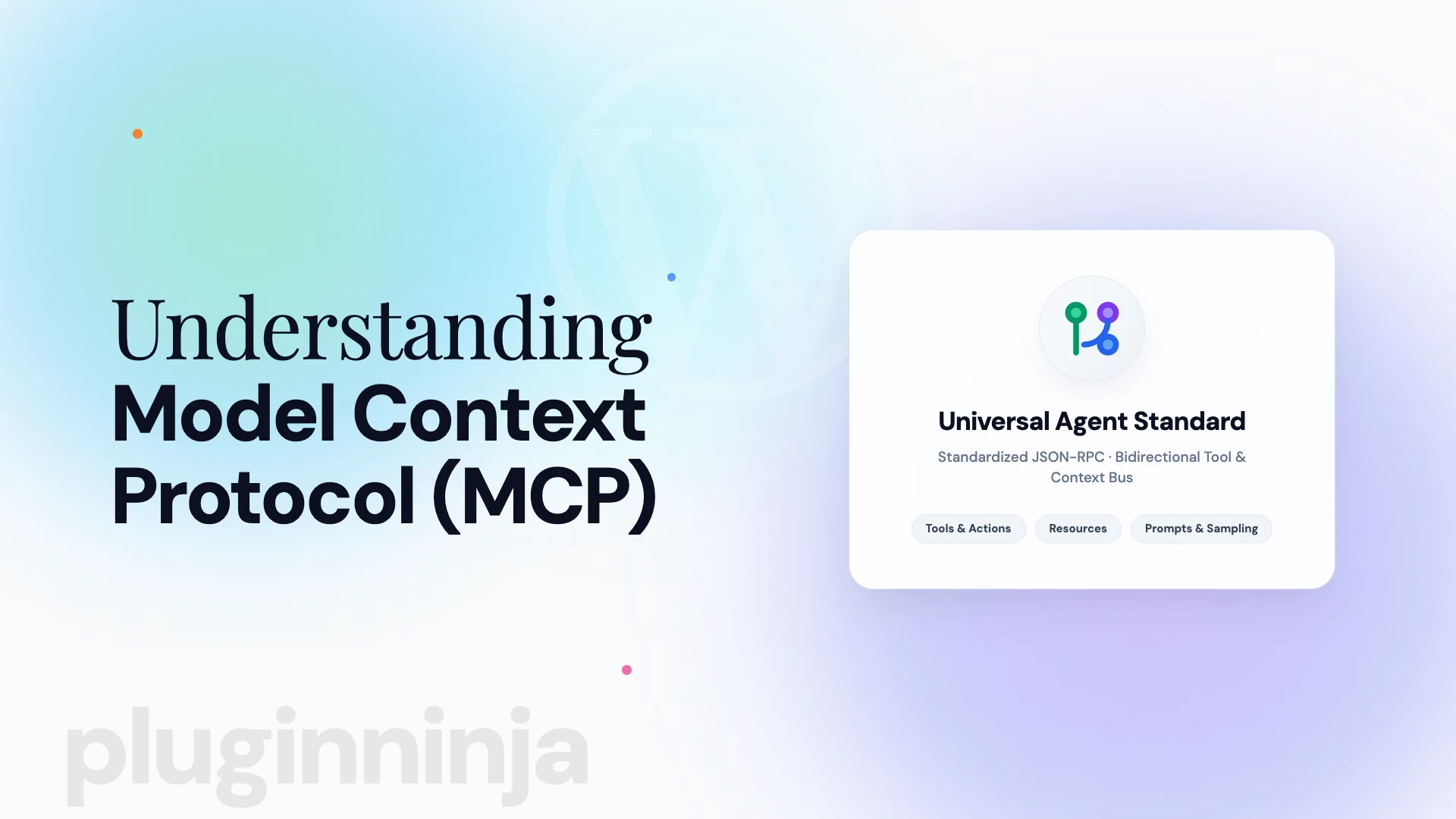
Understanding the model context protocol is essential for anyone building or deploying autonomous artificial intelligence systems in 2026. For the first two years of the generative AI boom, large language models operated like brilliant savants trapped in a glass room. They could write intricate code and analyze legal briefs, yet they lacked direct, standardized access to private files, company databases, and live developer infrastructure.
Table of Contents
Why the Model Context Protocol Matters in 2026
The core bottleneck facing enterprise AI adoption has never been raw model intelligence; it has always been context isolation. Before the arrival of this open specification, connecting an AI model to external services required custom API wrappers for every combination of application and tool. Implementing the model context protocol replaces this fragmented landscape with a single, universal standard often described by software architects as the USB-C of artificial intelligence.
Just as the Language Server Protocol revolutionized coding editors by separating language tooling from user interfaces, this open specification establishes uniform communication between AI assistants and operational data sources. Rather than maintaining dozens of custom connectors, developers build one compliant connector that functions effortlessly across every compatible client.
The Core Architecture of the Model Context Protocol
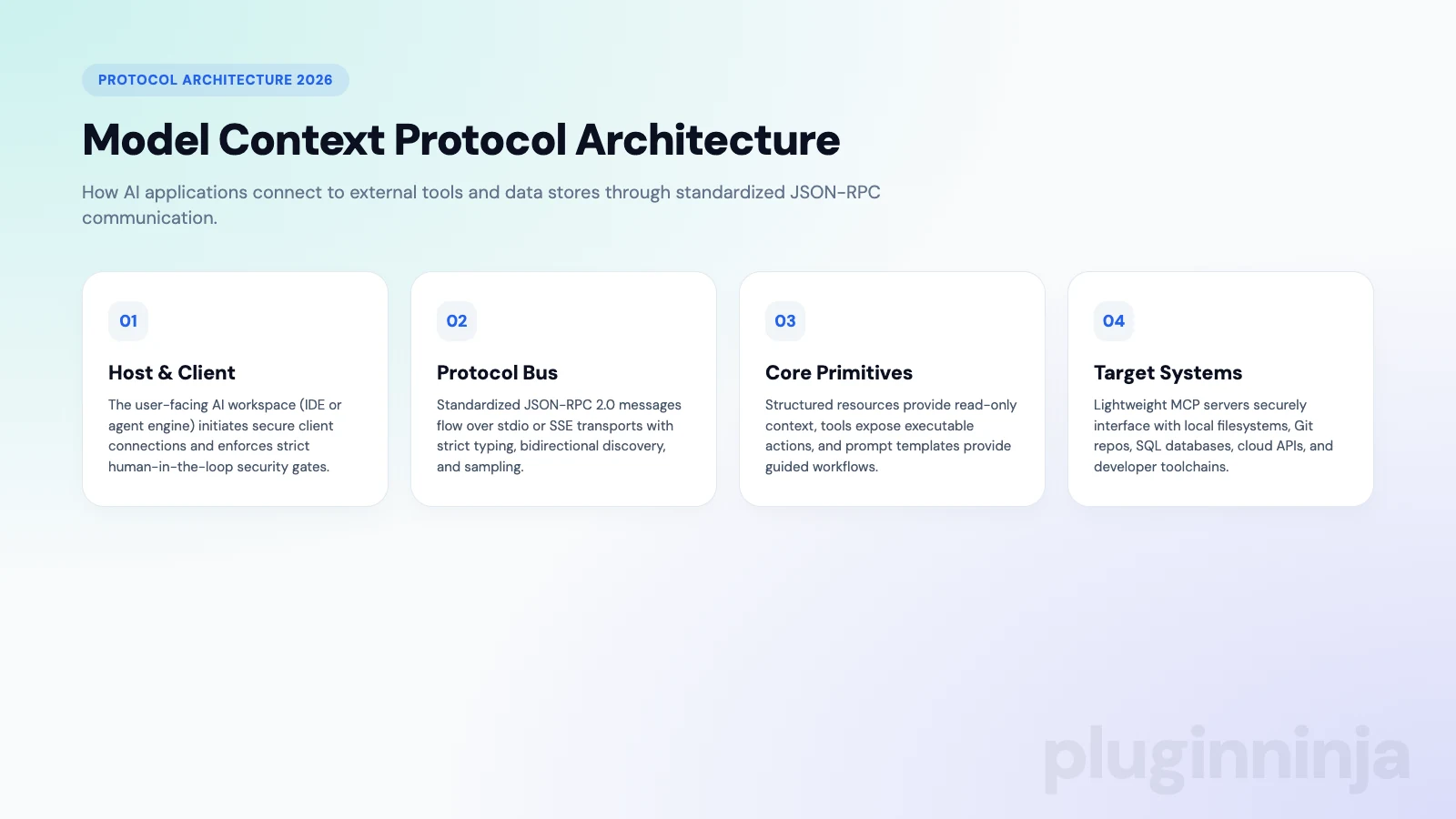
At an architectural level, the underlying standard functions on a lightweight client-host-server topology. This design ensures that credentials, execution sandboxes, and data governance stay firmly under user control while enabling flexible automation.
| System Component | Architectural Responsibility | Practical Implementation |
|---|---|---|
| Host Application | Coordinates user interaction and security gates | Antigravity, Cursor, Claude Desktop |
| Client Layer | Establishes 1:1 connections with protocol servers | Internal protocol client adapter |
| Server Layer | Exposes data records, file systems, and functions | Postgres adapter, GitHub runner, local file reader |
| Transport Layer | Transmits standardized JSON-RPC 2.0 messages | Local standard input/output (stdio) or Server-Sent Events (SSE) |
The Three Primary Primitives of Modern MCP
To give autonomous agents reliable structure, the protocol organizes capabilities into three distinct primitives:
- Resources: Passive, read-only data assets such as log outputs, schema files, and documentation that provide essential background information.
- Tools: Executable functions that allow agents to take concrete actions, including updating database rows, committing code, and dispatching webhook calls.
- Prompts: Pre-configured slash commands and guided templates provided directly by servers to optimize model interaction workflows.
Modern implementations also incorporate recursive sampling, allowing servers to request nested language completions through the host. This capability empowers multi-agent coordination without requiring servers to manage private API keys.
Custom Function Calling vs Standardized Protocol Tools
Prior to open protocol standards, tool calling relied on proprietary JSON schemas defined by individual model vendors. When engineering teams wanted to switch LLM providers, entire tool chains had to be rewritten. In contrast, standardized MCP tooling decouples tool implementation from the underlying model architecture, granting teams total vendor freedom.
Furthermore, standard tool protocols operate across local process streams rather than requiring external cloud webhooks. This architecture minimizes network latency, keeps private parameters off public endpoints, and enables instantaneous command execution directly within developer workspaces.
How MCP Transforms Software Development
The practical impact of standardized agent tooling centers on closing the gap between reasoning and action. Earlier chatbot assistants merely recommended code alterations in chat bubbles. When powered by standardized tool protocols, modern agents identify failing test cases, read local file hierarchies, author targeted code diffs, run verification test suites, and finalize Git commits.
This transition transforms artificial intelligence from an advisory novelty into a fully integrated operational partner. Teams manage scalable media systems with Ninja Media and leverage cloud infrastructure with Ninja Drive, applying automated workflows directly across their WordPress production stacks.
Enterprise Security and Local Data Governance
Security officers frequently voice valid concerns regarding cloud data harvesting when integrating artificial intelligence. Deploying the model context protocol addresses these security issues through local-first execution. Proprietary data stays strictly inside private servers or local developer workstations, communicating exclusively across authenticated JSON-RPC pipelines.
Furthermore, host applications enforce strict human-in-the-loop permission dialogs before executing external commands. If an automated script attempts to drop a database table or push code to production, the host pauses execution and requires explicit human verification.
Dynamic Grounding vs Static Vector Embeddings
Traditional Retrieval-Augmented Generation relies heavily on periodic chunking and vector database indexing. In dynamic environments, vector stores quickly become obsolete. Integrating live server connections enables real-time context grounding by querying current state directly from active databases and metrics monitors.
For official technical documentation and open-source specifications, visit the official Model Context Protocol specification. You can also explore practical engineering case studies and WordPress and AI development tutorials on our blog.
Key Challenges Facing Protocol Adoption
Despite its remarkable utility, adopting standardized agent tooling introduces specific architectural challenges. First, connecting dozens of servers simultaneously can saturate model context windows with lengthy tool definitions. Engineering teams must implement selective tool filtering to preserve token capacity for reasoning.
Second, granting execution capabilities to autonomous agents requires rigorous safeguards against prompt injection attacks. Developers must validate inputs thoroughly and sandbox system commands to prevent malicious prompt payloads from manipulating system tools.
Final Thoughts on Open Agent Standards
The widespread adoption of the model context protocol represents a defining shift in modern software engineering. By replacing fragile custom integrations with an open, composable standard, developers can connect AI reasoning directly to the tools and datasets that matter most. Embrace autonomous agent standards today to unlock the true potential of modern development.
Frequently Asked Questions About Model Context Protocol
The Model Context Protocol (MCP) is an open-source standard designed to establish secure, bidirectional communication between AI applications and external tools, files, and databases. It functions as a universal interface, enabling language models to inspect context and execute actions across diverse developer systems without bespoke custom integrations.
Traditional function calling uses proprietary JSON schemas tied to specific LLM providers, requiring developers to rebuild integrations when switching models. In contrast, MCP decouples tool execution from model architecture using an open JSON-RPC 2.0 contract, allowing a single MCP server to connect seamlessly with any compatible AI client or IDE.
MCP defines three primary primitives: Resources, Tools, and Prompts. Resources provide passive, read-only data such as log files and schema definitions. Tools expose callable functions that execute tasks in the environment, such as updating database rows or running shell commands. Prompts offer reusable templates and workflows provided by the server.
Yes. MCP is designed around local-first execution. Transport occurs via local standard input/output (stdio) or Server-Sent Events (SSE) within secure environments. Host applications enforce explicit human-in-the-loop authorization gates, ensuring that no sensitive commands or database mutations execute without direct operator consent.
MCP is widely adopted across modern developer environments, including Anthropic Claude Desktop, AI-first code editors like Cursor and Zed, autonomous engineering platforms like Antigravity, and enterprise command-line agents. A growing open-source ecosystem provides ready-to-run MCP servers for GitHub, PostgreSQL, Docker, Slack, and Google Drive.
MCP servers interface directly with the client host rather than speaking peer-to-peer. However, through MCP sampling capability, a server can request recursive model completions through the host application. This design allows multi-agent coordination and complex multi-step workflows while keeping security permissions centralized inside the host.

 Jakir


 Join Community